
Beauty & Skincare
Skincare Routine Order: What Goes First in the Morning and at Night?
Confused about what order to apply your skincare products? Here’s how I organize my morning and nighttime routine, from cleanser and toner to serum, moisturizer and SPF.
By Lena Sokolov
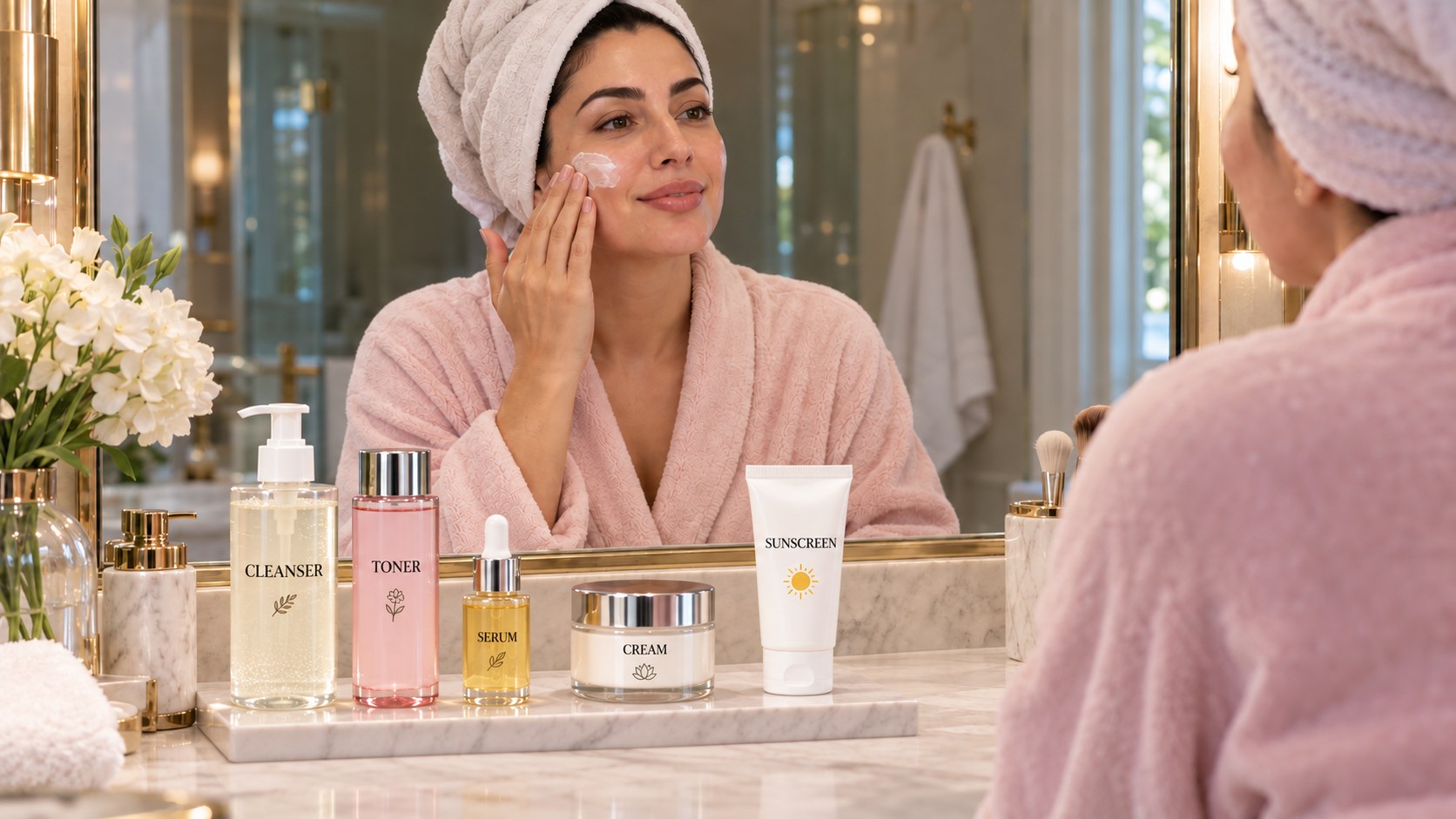
If you have ever stood in front of your bathroom counter holding a toner, serum, moisturizer and sunscreen and wondered, Which one goes first? you are definitely not alone.
Skincare can become confusing very quickly.
You may understand what each product is supposed to do, but then another question comes up:
What order am I supposed to use all of this?
Does toner go before serum? Does eye cream go before moisturizer? Where does exfoliation fit? What about a facial mask? And in the morning, does sunscreen go before or after moisturizer?
The good news is that once you understand the basic order, skincare becomes much easier.
In my own routine, I think about skincare in five main areas:
Cleanse. Tone. Treat. Moisturize. Protect.
That's also the foundation I use in my Essential Skincare Guide. From there, I add things like facial dry brushing, masks and eye care depending on what I'm doing that day.
Let's put everything in order.
Why Does Skincare Order Matter?
Skincare products have different purposes and textures.
Cleansing needs to happen before you start applying products because you want to begin with clean skin.
Toner comes early in my routine, followed by serum and other treatments. Moisturizer comes later to hydrate and support the skin barrier, and sunscreen belongs at the end of your morning skincare routine before makeup.
You don't need to make this complicated.
A simple way to remember my basic routine is:
Cleanse → Tone → Treat → Moisturize → Protect
But there are a few additional steps that don't fit neatly into that little formula.
So let's start with the morning.
My Morning Skincare Routine Order
In my Essential Skincare Guide, my complete morning regimen follows this order:
Cleanser → Dry Brushing → Facial Mask when using one → Toner → Serum → Eye and Face Moisturizer with SPF → Foundation
That is my fuller routine.
It doesn't mean that every woman needs to perform every one of those steps every morning.
Here's what each step is doing and where it belongs.
Step 1: Cleanser
I always want to start with clean skin.
Even though you washed your face the night before, oil and sweat can accumulate while you sleep.
Use a gentle cleanser appropriate for your skin and avoid formulas that leave your face feeling extremely tight or stripped.
This gives you a clean starting point for everything that follows.
Step 2: Exfoliation or Facial Dry Brushing When Appropriate
If I'm facial dry brushing, I do it on clean, dry skin before applying toner, serum or moisturizer.
Facial dry brushing is something I personally include in my skincare routine, and my technique is probably stronger than what I would tell someone else to begin with.
I use fairly heavy pressure rather than gentle strokes, and my skin tolerates it well.
But that's my skin.
If you're new to facial dry brushing, I wouldn't recommend immediately copying my pressure. Start more gently and pay attention to how your own skin responds.
And remember that exfoliation doesn't necessarily belong in every routine every day.
I explain this much more thoroughly in How Often Should You Exfoliate Your Face? What Women Over 30 Should Know.
Step 3: Facial Mask When I'm Using One
If I'm using a facial mask, it also comes before toner and serum in my routine.
Masks can serve different purposes.
Some are primarily hydrating. Others are intended for cleansing, exfoliating, brightening or other specific concerns.
In my guide, I discuss several different types of masks because I don't think every mask should be treated as though it does the same thing.
Follow the directions for the particular mask you're using, then continue with the rest of your skincare routine.
And again, a facial mask is an additional treatment.
You don't need to use a mask simply because you're doing your morning skincare.
Step 4: Toner
After cleansing and any rinse off treatment I'm doing, toner comes next.
This is one place where my skincare philosophy may be a little different from some very basic routines you'll find online.
I include toner as an important part of my routine.
I prefer a hydrating or balancing toner and apply it before serum.
So if you're wondering:
Toner or serum first?
For my routine, the answer is:
Toner first. Serum second.
I think of toner as part of preparing my skin for the products that follow.
Step 5: Serum
Serum comes after toner.
This is where you can start tailoring your routine to what you're trying to accomplish.
Different serums contain different ingredients and are designed for different concerns.
You might choose something for hydration, brightness, pigmentation, texture or other concerns.
In my Essential Skincare Guide, I discuss ingredients including vitamin C, hyaluronic acid, peptides and retinol.
But you don't need four different serums just because four different serums exist.
Choose treatments according to what your skin actually needs.
Step 6: Eye Cream
I also include separate eye care in my fuller routine.
The skin around the eyes is delicate and can have its own concerns, including dryness, puffiness, dark circles and fine lines.
I use a small amount around the eye area rather than treating eye cream like a face moisturizer.
If you're a complete skincare beginner, however, don't feel like you have to buy an eye cream before you can start taking care of your skin.
Build your routine gradually.
Step 7: Moisturizer
After my lighter products and treatments, I move to moisturizer.
Moisturizer helps hydrate the skin, reduce water loss and support the skin barrier.
The moisturizer you choose should also make sense for your skin type.
Dry skin may prefer something richer.
Oily or combination skin may prefer a lighter gel or water based moisturizer.
Sensitive skin may do better with simpler formulas and ingredients the skin already tolerates.
Step 8: Sunscreen
During the day, sunscreen is one of the most important parts of the routine.
I recommend broad spectrum SPF 30 or higher.
If your moisturizer already contains appropriate SPF protection, as in the morning routine shown in my guide, those steps may be combined into one product.
If you're using a separate moisturizer and sunscreen, sunscreen comes after your skincare products and before makeup.
So:
Moisturizer first. Sunscreen second.
And don't forget areas like your neck, upper chest, ears and hands.
Step 9: Makeup
If you're wearing makeup, it comes after your morning skincare and sunscreen.
Give your skincare a little time to settle if needed, then apply your makeup.
I consider makeup separate from skincare, but I include foundation at the end of the morning regimen in my Essential Skincare Guide because that's naturally where it fits when you're getting ready for the day.
My Night Skincare Routine Order
Nighttime is different.
In the morning, one of our biggest priorities is protection.
At night, I'm thinking about removing what has accumulated on my skin during the day and preparing my skin for the products I'm going to leave on overnight.
My complete nighttime regimen in the Essential Skincare Guide is:
Makeup Remover → Cleanser → Dry Brush or Facial Mask → Toner → Serum → Eye Cream → Night Cream
Let's go through that routine too.
Step 1: Remove Your Makeup
If you wear makeup, take it off before going to bed.
I like using micellar water makeup remover as the first step.
This begins breaking down and removing the makeup before I actually cleanse my skin.
I don't consider removing makeup and cleansing to be exactly the same thing.
Which brings us to the next step.
Step 2: Cleanse
After removing makeup, I use cleanser.
This is the double cleansing approach I describe in my Essential Skincare Guide:
Makeup remover first. Cleanser second.
The first step removes makeup.
The second cleanses away remaining makeup, oil, sunscreen and other impurities.
If you don't wear makeup, you obviously don't need to remove makeup that isn't there.
The point is simply to make sure your skin is actually clean before moving on.
Step 3: Dry Brushing, Exfoliation or Facial Mask When Appropriate
This is where one of these additional treatments may fit into my nighttime routine.
If I'm dry brushing, I want clean, dry skin.
If I'm using a rinse off facial mask, I also want to do that before applying the products I'm going to leave on my skin overnight.
But this is important:
Not every step is an everyday step.
Where something belongs in your routine and how frequently you should use it are two different questions.
For example, telling you where an exfoliating treatment belongs doesn't mean I'm telling you to exfoliate aggressively every night.
The type of treatment, your skin and the other products you're using all matter.
Step 4: Toner
Once cleansing and any rinse off treatment are finished, I apply toner.
Again, my order is:
Toner before serum.
This stays consistent between my morning and nighttime routines.
Step 5: Serum or Treatment
Next comes serum or another leave on treatment appropriate for your routine.
Nighttime is also when some women use ingredients such as retinol.
Retinol is generally used at night and can be helpful for concerns such as fine lines, texture and pigmentation.
But be careful about combining too many active treatments.
If you're using retinol, for example, you don't necessarily want to add aggressive exfoliation on top of it simply because both products are supposed to help your skin.
More treatment doesn't automatically mean more results.
Sometimes it simply means more irritation.
Step 6: Eye Cream
Next I apply eye cream to the eye area.
I discuss eye care much more extensively in my Essential Skincare Guide because the eye area can have several different concerns, including puffiness, dark circles, dryness and fine lines.
This is also an area where I personally use silicone facial patches at night.
They're part of my own routine and something I enjoy using.
As I explained in my article Skincare in Your 40s: What I've Changed in My Own Routine, however, I don't want to claim that silicone patches are the reason I don't have many visible wrinkles.
They're simply one of the things I personally use consistently.
Step 7: Night Cream or Moisturizer
My final regular skincare step at night is moisturizer or night cream.
At night, you obviously don't need SPF.
This is when I use a moisturizer appropriate for nighttime and allow it to remain on my skin while I sleep.
And then I'm done.
Your nighttime skincare routine doesn't need to turn into a 45 minute project unless you genuinely enjoy doing that.
Morning vs. Night Skincare: What's Actually Different?
The basic structure is similar.
You cleanse.
You apply your lighter products and treatments.
You moisturize.
But the purpose changes.
In the morning:
You're preparing your skin for the day and protecting it from UV exposure.
That's why sunscreen is essential.
At night:
You're removing makeup, sunscreen, oil and everything your skin has been exposed to throughout the day.
Then you're applying the products you want to leave on overnight.
That's why makeup removal and cleansing become especially important.
The routines don't need to contain exactly the same products.
The Simple Skincare Order to Remember
If all of this still feels like a lot, come back to the basic framework:
Morning
Cleanse → Tone → Treat → Moisturize → SPF
Then makeup if you're wearing it.
Night
Remove Makeup → Cleanse → Tone → Treat → Moisturize
Additional things like facial dry brushing, exfoliation and rinse off masks usually happen after cleansing and before your leave on products, when appropriate for the particular treatment.
That's the basic structure.
Everything else can be built around it.
Does Toner Go Before or After Serum?
Before.
In my routine, toner comes after cleansing and before serum.
So:
Cleanser → Toner → Serum
If you're also doing an exfoliating or rinse off treatment, that generally happens before toner in my routine.
Does Serum Go Before or After Moisturizer?
Before moisturizer.
Serums are generally lighter products and are applied earlier in the routine.
So:
Toner → Serum → Moisturizer
Does Eye Cream Go Before or After Moisturizer?
In my own complete routines, I use my eye care before finishing with my face moisturizer or night cream.
I apply it specifically to the eye area rather than spreading it over my entire face.
Does Sunscreen Go Before or After Moisturizer?
If you're using separate products:
Moisturizer first. Sunscreen second.
Sunscreen is the final skincare step in the morning before makeup.
If you're using a moisturizer formulated with SPF, as I show in my guide, those two steps can be combined.
Where Does Retinol Go?
Retinol is generally part of a nighttime routine.
It belongs in the treatment part of your routine rather than replacing your cleanser or moisturizer.
Exactly how you use it can depend on the particular product and how well your skin tolerates it, so follow the product directions.
If you're new to retinol, introduce it gradually.
And don't assume that because retinol can be helpful, using more of it or combining it with several other strong treatments will work faster.
Where Does Exfoliation Go?
It depends on the type.
For the facial dry brushing I personally do, I use it on clean, dry skin before toner, serum and moisturizer.
A rinse off exfoliating treatment would also generally happen before your leave on skincare products.
Chemical exfoliants designed to remain on the skin may have different directions.
This is why the instructions for your particular product matter.
And remember:
Order and frequency are not the same thing.
Just because an exfoliant belongs at a certain point in your routine doesn't mean you should use it every day.
Where Does a Facial Mask Go?
Again, it depends on the mask.
For a traditional rinse off facial mask, I generally use it after cleansing and before toner and serum.
But masks come in many forms.
An overnight moisturizing mask, for example, is obviously used differently from a clay mask that you apply and rinse away.
Follow the directions for the particular product you're using rather than assuming every mask belongs in exactly the same place.
Do You Have to Wait Between Skincare Products?
You don't need to turn your skincare routine into a stopwatch exercise.
For most basic products, I simply give each one enough time to settle into my skin before applying the next.
Some active ingredients or prescription products may have more specific directions, and those instructions should take priority.
What I don't want is for a beginner to think she needs to stand in the bathroom for five minutes between every bottle.
Skincare should fit into your life.
Not Every Step Is an Everyday Step
This may be one of the most important things in this article.
When you see a complete skincare routine written out, it can look like you're supposed to do every single step every morning and every night.
You're not.
Your basic daily routine may remain fairly consistent.
Then treatments are added according to your skin and what you're trying to accomplish.
Exfoliation is a perfect example.
Where it belongs in the routine is one question.
How often you should do it is another.
The same applies to masks and stronger treatments.
You don't need to throw everything you own at your face twice a day.
What If You're a Complete Beginner?
Start smaller.
If you've never had a real skincare routine before, don't look at my complete routine and think you need to purchase everything tonight.
Learn the basics.
Cleanse.
Tone.
Moisturize.
Protect your skin during the day.
Then begin adding treatments according to what your skin actually needs.
I explain this step by step in Skincare Routine for Beginners: Where to Start When You Don't Know What You Need.
Your skincare routine can grow as your knowledge grows.
Your Routine Doesn't Have to Look Exactly Like Mine
I think this is worth saying because I'm sharing my own routines throughout this website.
I want to show you what I do.
I want to explain why I do it.
And I want to share things I've learned from taking care of my skin over the years.
But that doesn't mean I expect you to copy every step.
My skin tolerates fairly heavy facial dry brushing.
Yours may not.
I enjoy facial masks.
You may prefer something else.
I use toner as a regular part of my routine.
Your dermatologist may recommend something different for a particular skin condition.
Skincare becomes much easier when you stop trying to copy another person's bathroom shelf and start understanding your own skin.
The Most Important Thing Is Consistency
You can own the most expensive serum in the world, but it isn't going to do much sitting unopened in your bathroom cabinet.
A routine you actually follow is more useful than an elaborate routine you do twice and abandon.
That's one of the things I've come to appreciate more as I've gotten older.
Skincare doesn't need to be perfect.
It needs to be something you can realistically continue.
Learn your order.
Choose products that make sense for your skin.
Pay attention to how your skin responds.
And stay consistent.
Want My Complete Morning and Nighttime Skincare Routine?
If you want to see how I put all of these steps together, I created my Essential Skincare Guide for women in their 30s and beyond.
Inside, I walk you through cleansing, toner, exfoliation, serums, facial masks, moisturizer, sunscreen, eye care, facial exercises and my complete morning and nighttime skincare regimens.
If you're building your routine from the beginning, read Skincare Routine for Beginners: Where to Start When You Don't Know What You Need.
If you want to understand exfoliation better, read How Often Should You Exfoliate Your Face? What Women Over 30 Should Know.
And if you're beginning to notice changes in your skin as you get older, read Skincare in Your 40s: What I've Changed in My Own Routine.
You can also visit my Beauty Favorites to see some of the skincare products and tools I personally enjoy using.
This article shares my personal skincare experience along with general educational information. It isn't medical advice. If you have a skin condition, persistent irritation or questions about prescription products or active skincare ingredients, talk with a qualified healthcare professional or board certified dermatologist.
You Might Also Like
Beauty & Skincare
Skincare Routine for Beginners: Where to Start When You Don’t Know What You Need
Skincare can feel overwhelming when you’re just starting. Here’s how to build a simple routine around the basics your skin actually needs.
Read More
Beauty & Skincare
How Often Should You Exfoliate Your Face? What Women Over 30 Should Know
How often should you exfoliate your face? It depends on your skin and how you exfoliate. Here’s what women over 30 should know about finding the right balance.
Read More
Beauty & Skincare
Skincare in Your 40s: What I’ve Changed in My Own Routine
My skincare routine hasn’t necessarily become more complicated in my 40s, but my focus has changed. Here’s what I’m doing differently for puffiness, firmness, moisture, and healthy-looking skin.
Read More