
Beauty & Skincare
Skincare in Your 40s: What I’ve Changed in My Own Routine
My skincare routine hasn’t necessarily become more complicated in my 40s, but my focus has changed. Here’s what I’m doing differently for puffiness, firmness, moisture, and healthy-looking skin.
By Lena Sokolov
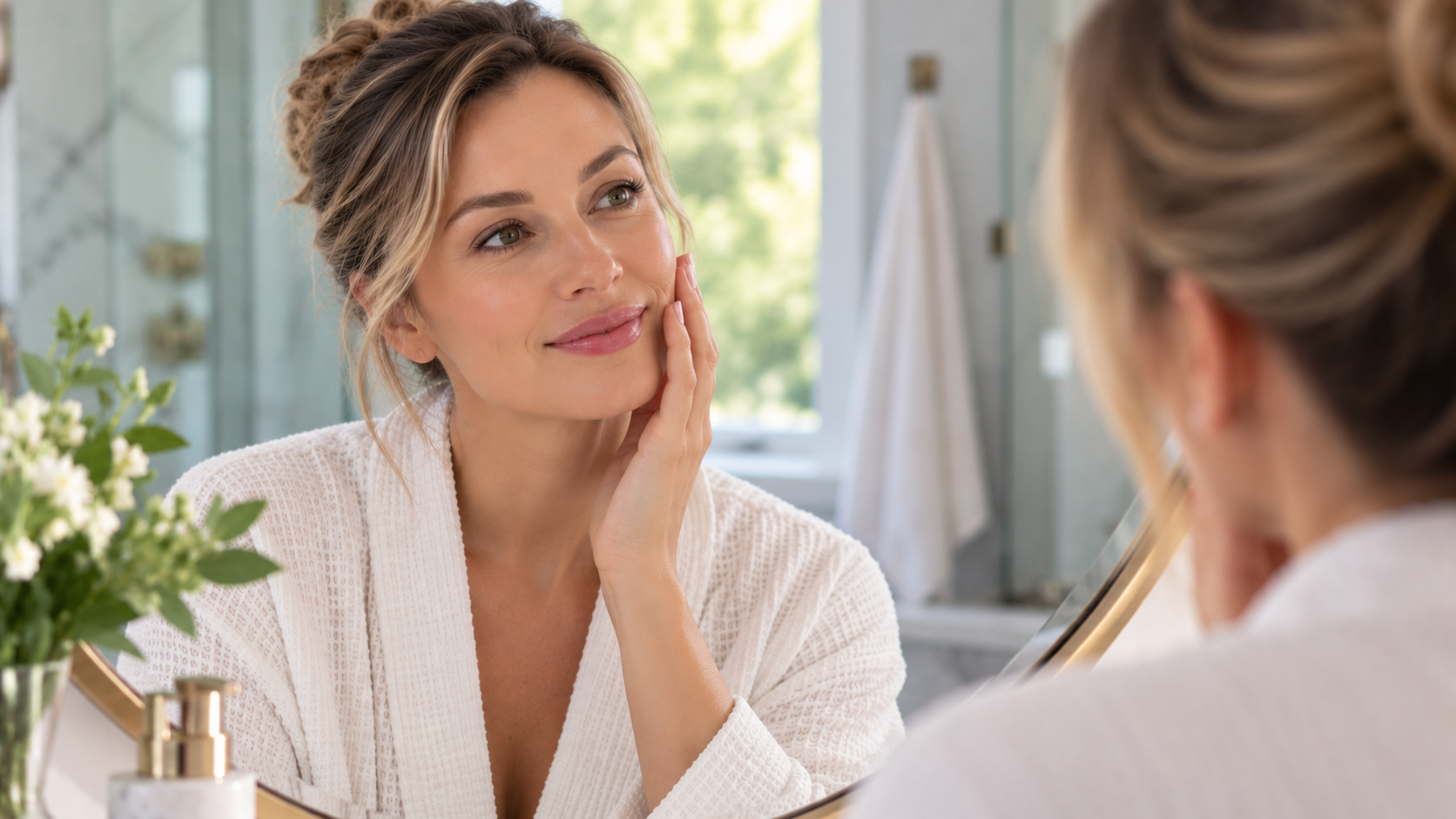
When I started thinking about what has actually changed about my skin in my 40s, I realized my answer may be a little different from what you usually read in articles about aging skin.
Wrinkles haven't been my biggest concern.
I've taken good care of my skin for years, and skincare has always been important to me. I also use silicone facial patches every night as part of my routine. I don't have many visible wrinkles at this point, although I can't say that the patches are the reason. Our skin is influenced by many things, including genetics, sun exposure, lifestyle, and the way we care for it.
What I have started noticing more in my 40s is puffiness and some changes in firmness. My skin doesn't always look quite as tight as it used to.
Because of that, my skincare hasn't necessarily become more complicated.
Instead, my focus has changed.
I'm paying more attention to facial exercises, consistency, sun protection, and taking care of the skin I have rather than constantly looking for another product that promises to make me look 20 again.
Here's what has changed for me, and what I think is worth knowing if you're taking care of your skin in your 40s too.
Your Skin in Your 40s May Not Look Like Someone Else's
I think this is important to say first.
There isn't one moment when you turn 40 and suddenly everyone's skin behaves the same way.
One woman may notice fine lines around her eyes.
Another may struggle with dryness.
Someone else may notice dark spots, changes in texture, or sagging.
For me, puffiness and changes in firmness have been more noticeable than wrinkles.
That's why I don't believe every woman in her 40s needs to follow exactly the same skincare routine.
Your routine should start with your skin, not your age.
The Biggest Change I've Noticed: More Puffiness
Puffiness is one of the things I notice more now than I did when I was younger.
And frustratingly, it isn't always the same from one day to another.
Sometimes your face simply looks fresh and rested. Other mornings, you look in the mirror and think, Where did that puffiness come from?
There can be many reasons for facial puffiness, including normal fluid retention, sleep, allergies, diet, hormones, and other factors.
So I don't look at every puffy morning as a sign that something is suddenly wrong with my skin.
But because I've noticed it more as I've gotten older, it has made me pay more attention to what makes my face look and feel refreshed.
That leads to one of the biggest things I've added more intentionally to my routine.
I'm Focusing More on Facial Exercises
Facial exercises have become more interesting to me as I've noticed changes in the way my face looks.
I like the idea of taking care of more than just the surface of my skin.
We spend plenty of time thinking about creams and serums, but our face also has muscles underneath the skin. So facial exercises are something I've started focusing on more as part of my overall routine.
I want to be careful here, though.
I don't want to tell you that doing a few facial exercises is going to magically lift sagging skin or replace a cosmetic procedure.
There has been some interesting research on facial exercise. In one small study of middle aged women, participants who completed a 20 week facial exercise program showed improvement in cheek fullness, and independent evaluators estimated them to look younger at the end of the study.
That's interesting to me, but it was also a very small study, and much more research is needed.
So I think of facial exercises the same way I think about many parts of self care:
I'm not looking for a miracle. I'm looking for simple things I can consistently do to take care of myself.
For me, facial exercises are one of those things.
What About Sagging Skin?
This is another area where I think we need realistic expectations.
There are so many creams marketed with words like lifting, firming, and tightening that it's easy to think we can put something on our face at night and wake up with significantly lifted skin.
Unfortunately, skincare doesn't work quite like that.
A good moisturizer can temporarily make skin look plumper and smoother. Certain skincare ingredients can also help improve texture, fine lines, and other signs of aging over time.
But a cream cannot physically lift significant sagging skin.
That doesn't mean skincare is useless. Far from it.
It just means we should understand what our products can and cannot do.
I would rather spend my money on products that support healthy looking skin than expect a jar of cream to completely change the structure of my face.
Wrinkles Haven't Been My Biggest Issue, But They're Very Common
My experience isn't going to be everyone's experience.
Many women start noticing more fine lines and wrinkles in their 40s, particularly around the eyes, forehead, and mouth.
So even though wrinkles haven't been my main concern, I don't want to ignore them.
One of the most important things we can do is also one of the simplest:
protect our skin from the sun.
Sun exposure contributes to premature skin aging, including wrinkles and uneven pigmentation.
This is why I keep coming back to SPF in my skincare articles.
You can buy beautiful serums and expensive anti aging creams, but if you're regularly exposing your skin to UV radiation without protection, you're missing an important part of caring for your skin as it ages.
The American Academy of Dermatology recommends broad spectrum, water resistant sunscreen with SPF 30 or higher when you'll be outdoors.
And remember the areas beyond your face: your neck, upper chest, ears, and hands.
I talked more about the hands specifically in my article How to Make Your Hands Look Younger: My Simple Hand Care Routine.
I Use Silicone Facial Patches at Night
This is one of the more personal parts of my routine.
I use silicone facial patches every night.
Because I don't have many visible wrinkles, it's tempting to look at something I've done consistently and say, This must be why.
But I don't think that's a responsible conclusion.
I can't tell you that silicone patches are the reason I don't have many wrinkles. I can't separate them from everything else I've done for my skin over the years, or from genetics and other factors I can't control.
What I can tell you is this:
They're part of my routine, I enjoy using them, and I've chosen to continue.
There is some limited research suggesting adhesive facial patches can temporarily improve the appearance of certain wrinkles, but that is very different from proving that wearing silicone patches prevents wrinkles from developing.
I think that distinction matters.
I want to share what I genuinely use without turning everything I like into a miracle product.
Moisture Becomes Even More Important
Even if dryness isn't your biggest skincare problem, it's worth paying attention to moisture as you get older.
Skin tends to become drier with age, and dryness can make fine lines and texture look more noticeable.
A good moisturizer doesn't have to cost a fortune.
What matters is finding something appropriate for your skin and actually using it.
If you're constantly switching products because something newer and more exciting appeared online, it can become difficult to tell what your skin actually likes.
I prefer consistency.
And if your skin has become drier in your 40s, don't assume you need to keep using exactly the same moisturizer you used years ago.
Your skin can change.
Your routine can change with it.
I Don't Think Turning 40 Means You Suddenly Need 15 Products
There seems to be an idea in beauty marketing that the older we get, the more products we need.
At 25, apparently we're allowed to own three bottles.
At 40, suddenly we need an entire bathroom cabinet.
I don't believe that.
Your basic skincare foundation is still surprisingly simple:
Cleanse. Moisturize. Protect.
Then you can add products based on what your skin actually needs.
If you're completely new to skincare, I wouldn't start by buying every product labeled "anti aging." Start with the basics first.
I explain exactly how to do that in my Skincare Routine for Beginners: Where to Start When You Don't Know What You Need.
Once you have your foundation, you can decide whether you want to address a particular concern.
What About Retinol and Other Anti Aging Ingredients?
If wrinkles or skin texture are becoming concerns for you, you may start hearing a lot about retinol.
Retinol belongs to a group of vitamin A derived ingredients called retinoids. These ingredients have evidence supporting their use for concerns including fine lines, skin texture, and pigmentation.
But stronger isn't always better.
Retinoids can cause dryness and irritation, particularly when you first start using them, so they are usually introduced gradually.
And they aren't appropriate for everyone, including during pregnancy.
This is another reason I don't like the idea of telling every woman, "You're 40 now, go buy this."
Your skincare should reflect your skin, your goals, and your individual circumstances. If you're unsure about active ingredients or have a skin condition, a dermatologist can help you decide what's appropriate.
Don't Forget Your Neck, Chest and Hands
One thing I think becomes increasingly obvious as we get older is that skincare shouldn't stop at the jawline.
Our neck, upper chest, and hands are exposed too.
If you're already applying moisturizer and sunscreen to your face, it doesn't take much more effort to think about these areas as well.
I especially think our hands get forgotten.
We wash them constantly, expose them to weather and sunlight, use cleaning products, and then wonder why they start looking dry.
That's actually why I made my younger looking hands video years ago and why it became the subject of one of the first articles on this website.
Taking care of ourselves doesn't need to stop at our face.
What I Care About More Now Than I Did When I Was Younger
As I've gotten older, I've become less interested in chasing perfection.
I'm more interested in maintenance.
I want healthy looking skin.
I want to protect what I have.
I want to stay consistent.
And when I notice something changing, like puffiness or firmness, I want to learn what I can realistically do about it rather than immediately believing the first product that promises to reverse aging.
Right now, that means I'm focusing more on facial exercises while continuing the skincare habits that have already been part of my life.
It also means accepting something important:
Aging isn't a skincare failure.
Our faces are supposed to change.
Taking care of ourselves isn't about making sure nobody can guess our age. It's about looking and feeling our best while we're living it.
My Skincare Priorities in My 40s
If I had to simplify what matters most to me now, it would be this:
Consistency over complexity.
I would rather consistently care for my skin than constantly chase the newest trend.
Sun protection.
Not glamorous, but extremely important.
Moisture.
Healthy looking skin needs support, especially as it becomes naturally drier with age.
Paying attention to changes.
For me, that's puffiness and firmness. Your concerns may be completely different.
Facial exercises.
This is an area I'm personally exploring more because it relates to the changes I've noticed.
Realistic expectations.
A moisturizer can moisturize. A serum may improve certain skin concerns. But no skincare product can stop us from aging, and I don't think that should be our goal anyway.
Your 40s Aren't Too Late to Start Taking Care of Your Skin
Maybe you've been taking care of your skin for years.
Or maybe you're reading this at 42, 47, or 55 and thinking, I really haven't done much for my skin at all.
Start now.
You haven't missed your chance.
You don't need to buy everything tomorrow.
Begin with a simple routine, learn what your skin needs, protect it from the sun, and build from there.
The goal isn't perfect skin.
The goal is well cared for skin and feeling good about taking care of yourself.
Want a Simple Skincare Routine You Can Actually Follow?
If you're trying to figure out where cleanser, toner, serum, moisturizer, SPF, exfoliation, masks, and other skincare steps fit, I created my Essential Skincare Guide to make the process easier.
It walks you through the basics so you can build a routine without feeling like you need every skincare product on the shelf.
You can also visit my Beauty Favorites to see some of the products and tools I personally enjoy using.
This article shares my personal skincare experience along with general educational information. It isn't medical advice. Facial puffiness can have many causes. If you develop persistent or sudden facial swelling, significant skin changes, irritation, or another concern, talk with a qualified healthcare professional or board certified dermatologist.
You Might Also Like
Beauty & Skincare
Skincare Routine for Beginners: Where to Start When You Don’t Know What You Need
Skincare can feel overwhelming when you’re just starting. Here’s how to build a simple routine around the basics your skin actually needs.
Read More
Beauty & Skincare
How to Make Your Hands Look Younger: My Simple Hand-Care Routine
Our hands can show signs of aging too. Here’s the simple routine I use to exfoliate, moisturize, protect, and care for my hands as I get older.
Read More