
Beauty & Skincare
How Often Should You Exfoliate Your Face? What Women Over 30 Should Know
How often should you exfoliate your face? It depends on your skin and how you exfoliate. Here’s what women over 30 should know about finding the right balance.
By Lena Sokolov
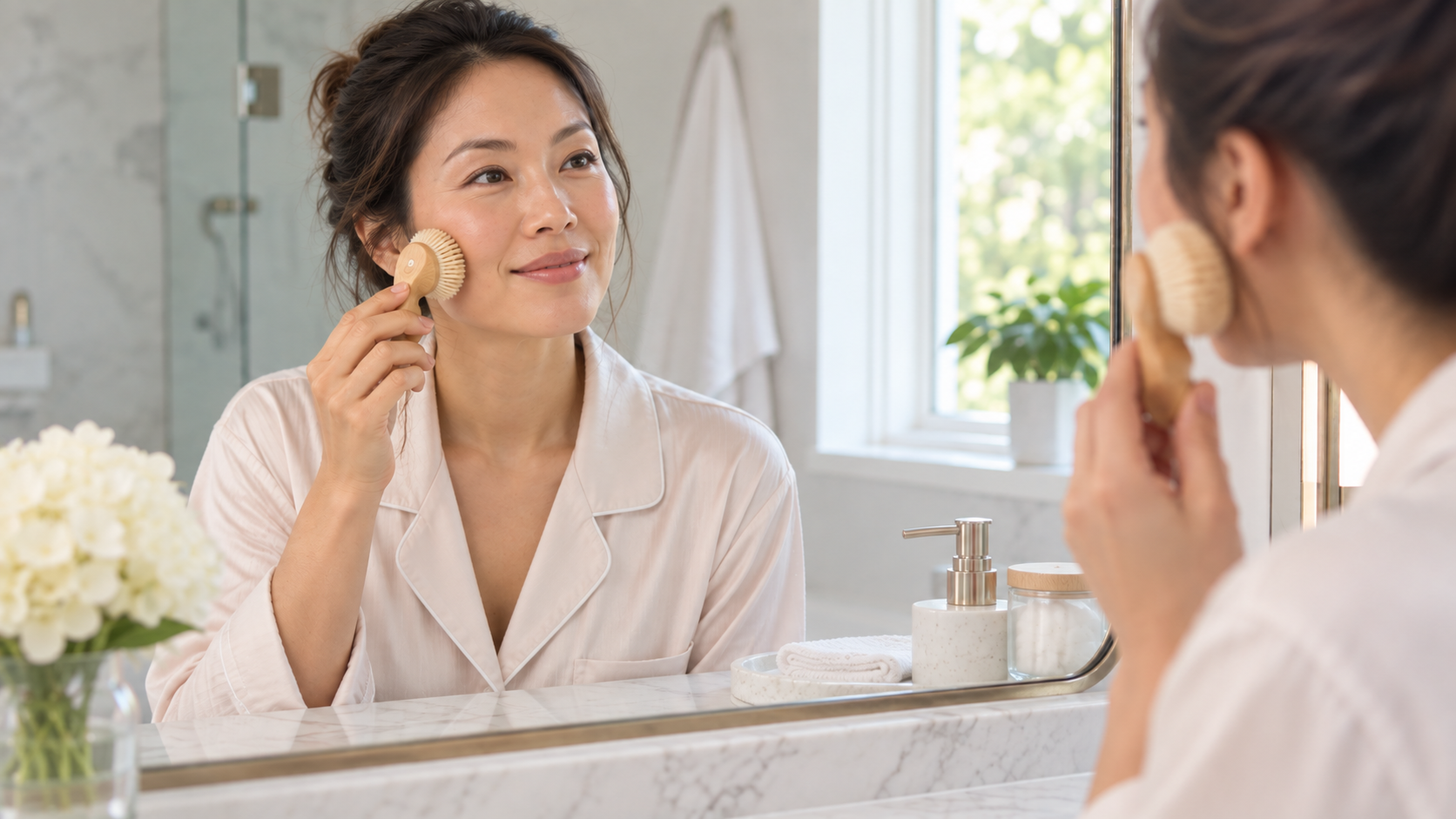
Exfoliation is one of those skincare steps that can make your skin feel incredibly smooth and refreshed.
But it is also very easy to overdo.
When women hear that exfoliation removes dead skin cells and can help dull skin look smoother and brighter, the natural reaction is to think that doing it more often must give better results.
But with exfoliation, more is not always better.
I include exfoliation as part of my own skincare routine, including facial dry brushing, but there isn't one exfoliation schedule that is right for every woman.
How often you should exfoliate depends on your skin, the type of exfoliation you're using, and the other products in your skincare routine.
So if you're wondering whether you should exfoliate every day, once a week, or somewhere in between, let's make it simple.
How Often Should You Exfoliate Your Face?
There isn't one number that works for everyone.
For many women, exfoliating once or twice a week may be a reasonable place to start, but your skin may need more or less depending on your skin type and the method you're using.
The American Academy of Dermatology recommends choosing your exfoliation method according to your skin type and explains that, generally, the more aggressive the exfoliation method, the less frequently it should be used.
That's an important distinction.
Using a facial brush isn't the same as applying a chemical exfoliant.
Using a scrub isn't the same as having a professional chemical peel.
And none of those are exactly the same as microdermabrasion.
So when someone asks me, "How often should I exfoliate?"
My first question would be:
How are you exfoliating?
Why Exfoliate Your Skin in the First Place?
Our skin naturally sheds dead skin cells, but this process can become slower as we get older.
When dead skin cells remain on the surface, skin can sometimes look dull, dry, rough or uneven.
Exfoliation helps remove some of those dead surface cells.
That's why your skin can feel so smooth afterward.
In my Essential Skincare Guide, I include exfoliation as part of caring for skin in your 30s and beyond because it can be a useful addition to a good skincare routine.
But exfoliation is still only one part of skincare.
You still need the basics.
Cleanse. Tone. Treat. Moisturize. Protect.
Exfoliating your face more aggressively cannot make up for skipping the everyday habits that support healthy looking skin.
Does Your Skin Need More Exfoliation After 30 or 40?
Not necessarily.
I don't think we should look at skincare as:
I'm 40 now, so I need to exfoliate three times a week.
Your birthday doesn't determine your exfoliation schedule.
Your skin does.
As we get older, we may notice more dryness, dullness, uneven texture, pigmentation or fine lines.
That may make exfoliation more appealing because we're paying more attention to the texture and appearance of our skin.
At the same time, skin can become drier or more sensitive with age.
So this isn't the time to attack your face trying to scrub the years away.
The goal is to find the type and frequency of exfoliation that works for your skin.
Physical vs. Chemical Exfoliation
One of the first things to understand is that there are different ways to exfoliate.
Physical Exfoliation
Physical, or mechanical, exfoliation physically removes dead skin cells from the surface.
This can include things like:
Facial brushes.
Facial dry brushing.
Scrubs.
Sponges or washcloths.
Microdermabrasion.
The amount of exfoliation you get can vary enormously depending on what you're using and how much pressure you're applying.
Chemical Exfoliation
Chemical exfoliation uses ingredients that loosen or remove dead surface skin cells rather than physically brushing or scrubbing them away.
You may see ingredients such as alpha hydroxy acids or beta hydroxy acids in skincare products.
Chemical exfoliation can range from relatively mild products designed for home use to much stronger professional chemical peels.
This is why I don't like giving one universal rule for exfoliation.
Saying "exfoliate twice a week" doesn't tell us enough.
What are you exfoliating with?
That matters.
My Experience With Facial Dry Brushing
Facial dry brushing is one of the ways I personally exfoliate my skin.
And I want to be completely honest about how I do it.
I actually use fairly heavy pressure rather than gentle strokes, and my skin tolerates it well.
That's what works for my skin.
But I don't want you to read that and immediately assume that you should use heavy pressure too.
Your skin may respond very differently, especially if it is sensitive, irritated, very dry or acne prone.
General dermatology guidance recommends using light strokes when exfoliating with a brush because aggressive mechanical exfoliation can irritate some skin types.
This is an important distinction I want to make throughout this website:
I can tell you what I personally do without telling you that your skin needs exactly the same thing.
I've spent years paying attention to my skin and how it responds. Facial dry brushing is something I've chosen to keep in my routine because I enjoy it and my skin tolerates the way I do it.
If you've never dry brushed your face before, I would not begin by copying my pressure.
Start more gently and see how your skin responds.
And never dry brush skin that is already irritated, injured or inflamed.
Can You Exfoliate Your Face Every Day?
This is where the type of exfoliation becomes especially important.
I don't think "Can I exfoliate every day?" has a simple yes or no answer without knowing what you're using.
A mild product that has some exfoliating properties is very different from aggressively scrubbing your face every morning.
And a professional chemical peel obviously isn't something you would treat like your daily cleanser.
The American Academy of Dermatology advises that the more aggressive your exfoliation method is, the less often you generally need to do it.
So instead of deciding that you must exfoliate every day, pay attention to what your skin is telling you.
If your skin feels comfortable, looks healthy and isn't becoming increasingly dry, red or sensitive, your routine may be working well for you.
If your face starts protesting, listen to it.
How Often Should You Exfoliate Based on Your Skin Type?
Your skin type matters.
Dry Skin
If your skin is already dry, be careful about adding too much exfoliation.
You may find that exfoliating less frequently or choosing a milder method works better for you.
And always follow exfoliation with moisturizer.
Oily Skin
Oily or thicker skin may tolerate more frequent exfoliation than dry or sensitive skin.
That still doesn't mean you need to scrub aggressively every day.
More oil does not make your skin indestructible.
Combination Skin
Combination skin can be tricky because different areas of your face may behave differently.
You may have an oily forehead and nose but drier cheeks.
Your entire face doesn't necessarily need to be treated exactly the same way.
Sensitive Skin
If your skin stings, burns or becomes irritated easily, physical exfoliation may be too aggressive for you.
This is one situation where I especially would not recommend copying the pressure I personally use when facial dry brushing.
Your skin needs its own routine.
Mature Skin
I don't think "mature skin" automatically means you need more exfoliation.
You may appreciate exfoliation because of changes in texture or dullness, but you also need to pay attention to dryness and sensitivity.
I would much rather see a woman exfoliate less frequently and have comfortable, healthy looking skin than exfoliate aggressively because she's trying to erase every sign of aging.
Can You Exfoliate While Using Retinol?
This is an important question because so many women are adding retinol to their skincare routines.
Retinol itself can cause dryness and irritation, especially when you're first starting.
If you're also exfoliating aggressively, you may be asking your skin to tolerate too much at once.
The American Academy of Dermatology specifically advises considering products you already use before adding exfoliation. Retinol and prescription retinoids can make skin more sensitive, and combining them with exfoliation can worsen dryness or irritation.
So if you're using retinol, don't automatically pile an aggressive exfoliation routine on top of it.
Pay attention to your skin.
And if you're using prescription skincare or aren't sure how to combine active ingredients, talk with your dermatologist.
How Do You Know If You're Over Exfoliating?
This is probably more important than finding the "perfect" number of times to exfoliate.
Your skin will often tell you when you're doing too much.
Watch for changes such as:
Redness.
Burning or stinging.
Unusual sensitivity.
Dryness.
Flaking or peeling.
Tightness.
Irritation.
Products that normally feel comfortable suddenly stinging when you apply them can also be a sign that your skin barrier is irritated.
If that starts happening, don't respond by exfoliating again because you see flaky skin.
Give your skin a break.
Go back to a simple routine and focus on gentle cleansing and moisturizing while your skin recovers.
And remember:
Your skin does not have to hurt for your skincare to be working.
What About Facial Scrubs?
Scrubs are another form of physical exfoliation.
They use small particles to physically remove dead surface skin cells.
If you like using a scrub, pay attention to how your skin feels afterward.
You don't need to scrub as hard as possible to get the benefit.
And I would be especially careful about combining several physical exfoliation methods at the same time.
If you've already dry brushed your face, for example, think before immediately following it with an aggressive scrub.
This is where skincare routines sometimes become unnecessarily complicated.
You don't have to do everything in one night.
What About Chemical Peels?
Chemical peels are a different category.
They use chemical solutions to exfoliate the skin and vary considerably in strength.
Some mild exfoliating acids are formulated into products designed for home use, while stronger chemical peels should be performed by qualified professionals.
This is not an area where I believe stronger automatically means better.
The appropriate treatment depends on your skin and what you're trying to accomplish.
If you're considering a stronger peel, especially if you have sensitive skin, pigmentation issues, acne, or you're already using active skincare ingredients, professional guidance is worth considering.
What About Microdermabrasion?
Microdermabrasion is another form of physical exfoliation.
A specialized device removes the uppermost layer of skin, and professional microdermabrasion is commonly used to address concerns such as texture, fine lines and certain pigmentation issues.
Again, this isn't equivalent to using a facial brush at home.
That's why frequency recommendations need context.
When we're talking about exfoliation, we're talking about a very broad category of treatments.
What Should You Do After Exfoliating?
Don't forget the rest of your skincare routine.
After exfoliation, I think moisturizing is especially important.
Exfoliation can leave skin drier, and the American Academy of Dermatology recommends applying moisturizer immediately afterward.
And during the day, don't forget sun protection.
I recommend broad spectrum sunscreen with SPF 30 or higher as part of your regular morning routine.
This is especially important when you're using skincare products or treatments that may make your skin more sensitive to sunlight.
Exfoliation isn't supposed to exist separately from everything else you're doing for your skin.
It should fit into your complete routine.
More Exfoliation Doesn't Mean Younger Skin
I think this is especially important for women in their 30s, 40s and beyond.
When we start noticing changes in our skin, it's very easy to become aggressive.
A little dullness appears.
Scrub it.
A fine line appears.
Buy an acid.
Skin texture changes.
Add another treatment.
Before long, you're doing so much to your face that your skin is irritated all the time.
That's not my idea of taking good care of your skin.
I absolutely believe exfoliation can have a place in a good skincare routine. It's part of my own routine.
But I don't think our goal should be to remove as much skin as possible or constantly chase that freshly exfoliated feeling.
The goal is healthy looking, well cared for skin.
My Approach: Pay Attention to Your Own Skin
If you've read some of my other skincare articles, you've probably noticed a theme.
I don't believe every woman needs exactly the same routine.
I use facial dry brushing.
I use fairly heavy pressure.
My skin tolerates it well.
Someone else's skin may hate it.
Another woman may love a chemical exfoliant and have no interest whatsoever in using a facial brush.
That's okay.
The important thing is understanding what you're doing and paying attention to how your skin responds.
If you're new to exfoliation, start slowly.
Don't introduce several aggressive methods at once.
Moisturize afterward.
Protect your skin from the sun.
And if something is making your skin increasingly irritated, don't keep doing it simply because someone online told you it's supposed to be good for you.
Consistency matters, but so does knowing when to stop.
Want to Understand Where Exfoliation Fits Into Your Complete Skincare Routine?
Exfoliation is only one piece of skincare.
If you're trying to understand how cleanser, toner, serum, moisturizer, SPF, exfoliation, facial masks, eye care and other treatments fit together, I created my Essential Skincare Guide for women in their 30s and beyond.
I walk you through the different steps and explain how I incorporate them into a complete morning and nighttime skincare routine.
If you're just beginning to build your routine, you can also read my Skincare Routine for Beginners: Where to Start When You Don't Know What You Need.
And if you're starting to notice changes in your skin as you get older, read Skincare in Your 40s: What I've Changed in My Own Routine.
You can also visit my Beauty Favorites to see some of the skincare products and tools I personally enjoy using.
This article shares my personal skincare experience along with general educational information. It isn't medical advice. If you have a skin condition, persistent irritation, active acne, unusual pigmentation or questions about exfoliating while using prescription treatments, talk with a qualified healthcare professional or board certified dermatologist.
You Might Also Like

Beauty & Skincare
Skincare Routine for Beginners: Where to Start When You Don’t Know What You Need
Skincare can feel overwhelming when you’re just starting. Here’s how to build a simple routine around the basics your skin actually needs.
Read More
Beauty & Skincare
Skincare in Your 40s: What I’ve Changed in My Own Routine
My skincare routine hasn’t necessarily become more complicated in my 40s, but my focus has changed. Here’s what I’m doing differently for puffiness, firmness, moisture, and healthy-looking skin.
Read More
Beauty & Skincare
How to Get Rid of Puffy Eyes: What I Do When My Eyes Look Tired and Swollen
Wake up with puffy eyes? Learn common causes of under eye puffiness, simple ways to reduce it, what I do, and why some under eye bags need a different approach.
Read More