
Cleaner Living
Glass vs. Plastic Food Storage: Is It Really Worth Switching?
Is glass really better than plastic for storing food? Here's why I prefer glass when it's practical, especially for foods I'm going to reheat, without throwing away everything I already own.
By Lena Sokolov
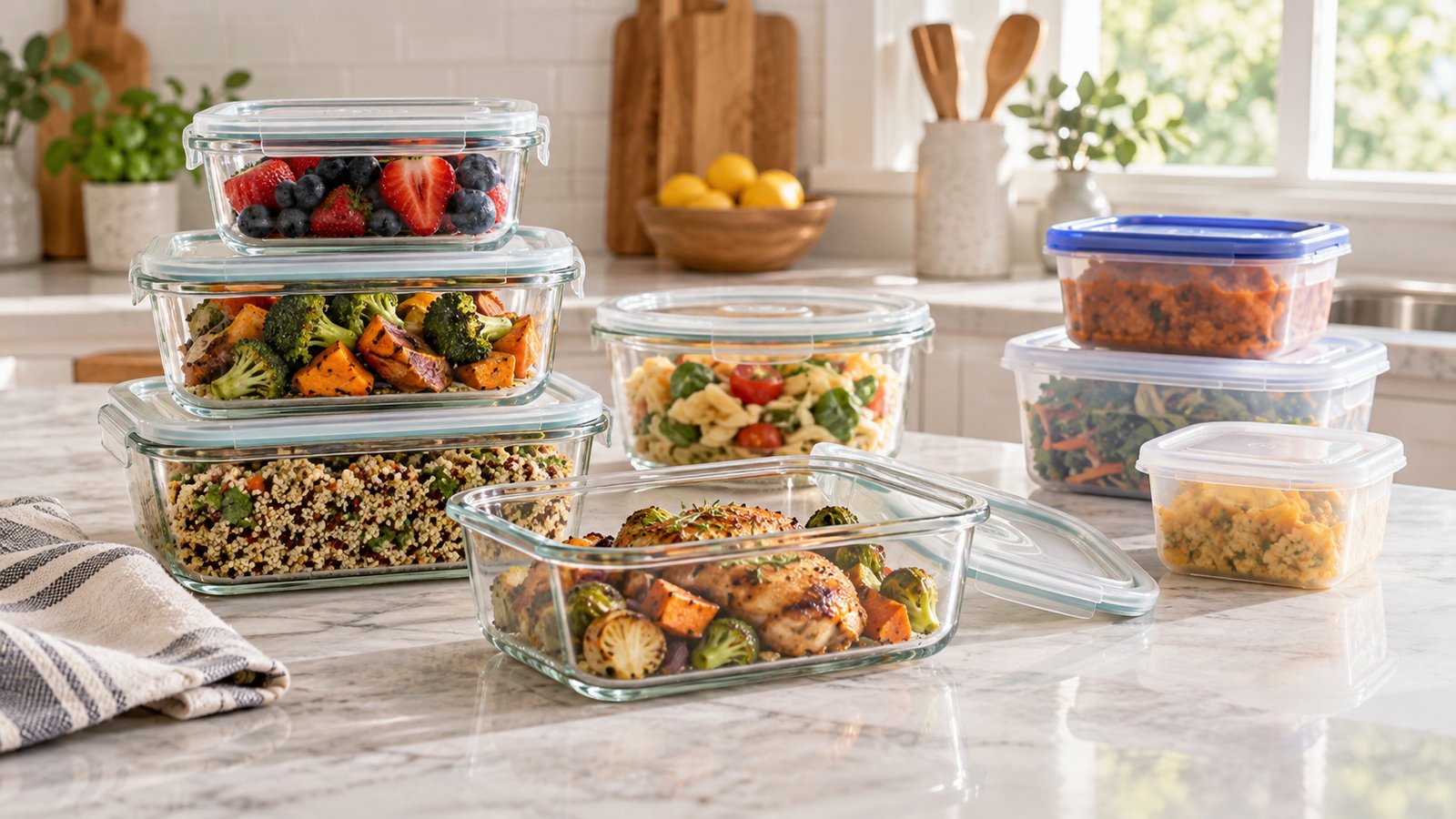
I've been trying to make some cleaner choices in my everyday life, but there's one thing I don't want cleaner living to become:
Throwing away everything I own because the internet told me it's toxic.
I don't think taking care of ourselves has to come from fear.
So when I started thinking more about plastic food containers, I wanted to understand something very practical.
Is glass really better than plastic for storing food?
Do we need to replace every plastic container in the kitchen?
And if you already have a cabinet full of perfectly usable plastic containers, should you actually throw them all away?
After looking more closely at this question, my approach is pretty simple:
When it's practical, I prefer glass for food storage, especially for foods I'm going to heat. But I don't think you need to panic about every piece of plastic in your kitchen.
Here's why.
Why Are People Concerned About Plastic Food Containers?
Plastic is incredibly convenient.
It's lightweight.
It doesn't shatter easily.
It's inexpensive.
It's easy to take to work, school or on a trip.
That's why so many of us have used plastic food containers for years without thinking very much about them.
The concern is that food contact isn't always completely one way. Depending on the type of material and how it's used, substances from food packaging and containers can migrate into food.
In fact, the FDA considers migration when evaluating food contact substances and their intended uses.
There is also growing research into microplastics and nanoplastics.
Researchers are finding tiny plastic particles in our environment, food and human tissues. But there is still a lot scientists are trying to understand about what different levels of exposure mean for long term human health.
I think that's an important distinction.
We know exposure happens. We don't yet have every answer about what that exposure means.
So I don't think fear is helpful.
But reducing unnecessary exposure when there is a simple alternative seems reasonable to me.
Why I Prefer Glass for Food Storage
Glass has several things going for it.
It doesn't contain the same plastic polymers and additives as plastic containers.
It's easy to clean.
It doesn't usually hold onto food smells or stains the way some plastic containers can.
You can see exactly what's inside.
And depending on the specific container and manufacturer's instructions, many glass containers can go from refrigerator to microwave without transferring the food into another dish.
Public health guidance increasingly suggests choosing glass, ceramic or stainless steel for food storage when practical.
For me, that makes glass a very easy swap.
Not because I believe plastic is poisoning me every time I touch it.
Simply because if I have two convenient options and one reduces my food's contact with plastic, I'm comfortable choosing that one.
Heat Is Where I Pay the Most Attention
If you're not ready to replace your food containers, this is probably the change I would think about first.
Try not to heat food in random plastic containers.
Heat matters because food contact materials are evaluated for specific conditions of use, including temperature. FDA testing guidance recognizes that migration can depend on temperature, food type and intended use.
Not every plastic container is designed to withstand the same temperatures.
Some are intended only for cold storage.
Some are specifically designed for microwave use.
Some takeout containers were never intended to become permanent reheating dishes.
The FDA notes that some plastics should not be used in a microwave because heat from the food can cause them to melt, and consumers should follow the container and microwave manufacturer's directions.
More recent microplastics research has also raised questions about particle release during heating. UC Davis Health currently recommends transferring food from plastic to glass or ceramic before microwaving as a practical way to reduce microplastic exposure.
That's an easy habit.
Store it in plastic if that's what you have. Transfer it to glass or ceramic before heating.
You don't necessarily have to redo your entire kitchen today.
What About Plastic Labeled “Microwave Safe”?
This is where the conversation needs some nuance.
“Microwave safe” doesn't mean the container is made of glass.
It means the product is intended for that type of use according to its specifications.
FDA regulates food contact substances based on their intended conditions of use, and microwave applications can have their own migration testing conditions.
So I wouldn't tell someone that using a properly designed microwave safe container once means she's harmed herself.
That's not supported.
At the same time, if my leftovers are already sitting in a glass container, I don't have to think about it.
I can simply heat them in the glass, assuming that particular container is microwave safe.
That's one reason I like glass.
It makes the decision easy.
Is All Plastic the Same?
No.
“Plastic” is an enormous category.
Different plastics are made from different materials and intended for different uses.
That's another reason statements such as “plastic is toxic” aren't particularly useful.
Which plastic?
Used how?
With what food?
At what temperature?
For how long?
Those questions matter.
The FDA regulates food contact materials based on intended uses and evaluates information about migration and consumer exposure as part of that process.
So rather than trying to memorize every plastic resin code in my kitchen, I prefer a simpler approach.
When glass is convenient, I use glass.
When I use plastic, I use it according to its intended purpose.
And I'm especially thoughtful about heat.
What About BPA?
BPA is probably one of the reasons so many people began thinking about plastic food containers in the first place.
You'll now see BPA FREE printed on many plastic products.
BPA is used in certain polycarbonate plastics and food contact applications.
FDA's current position is that approved uses of BPA in food containers and packaging are safe, while the agency continues to monitor new scientific research.
That's worth knowing because online conversations sometimes make it sound as though any product that has ever involved BPA is automatically dangerous.
At the same time, seeing “BPA free” on a container doesn't answer every possible question about that container.
There are many different types of plastic and many different chemicals used to make them.
For me, that's another reason I prefer not to make purchasing decisions based on one marketing phrase alone.
What About Microplastics?
This is probably the bigger question now.
Microplastics are tiny plastic particles, and nanoplastics are even smaller.
Exposure appears to be widespread, and researchers are actively studying where these particles come from, how they enter our bodies and what their health effects may be.
But there's an important part of this conversation that sometimes gets lost online:
Scientists are still learning what this means for human health.
UC Davis Health makes this point while still recommending simple ways people can reduce exposure, including not microwaving food in plastic and choosing glass or stainless steel for storage when practical.
I like that approach.
We don't have to choose between:
“Microplastics are completely harmless.”
and
“Plastic is poisoning all of us.”
There's a lot of space between those two statements.
We can acknowledge uncertainty and still make reasonable choices.
Is Glass Completely Risk Free?
Glass has disadvantages too.
It can break.
It's heavier.
It can be more expensive initially.
And not every glass container is safe for every temperature change.
You still need to follow the manufacturer's instructions.
Putting very cold glass into extreme heat, for example, may damage some types of glass.
Glass isn't magical.
It's simply a material I often prefer for food storage.
Glass vs. Plastic for Leftovers
This is probably where I would make the switch first.
If I'm making dinner and saving leftovers for tomorrow, glass is extremely convenient.
Food goes into the container.
Container goes into the refrigerator.
Tomorrow I can often reheat it in the same container, as long as that specific container is designed for microwave use.
Less transferring.
Less plastic contact.
Easy cleanup.
That's the kind of cleaner living swap I like.
It doesn't make my life harder.
It actually makes sense in my normal routine.
What About Cold Food?
This is where I'm much less concerned about being perfect.
If I have something cold stored in a plastic container, I'm not going to panic and throw it away.
Temperature and intended use matter when thinking about food contact materials.
So if you're trying to make gradual changes, I would prioritize:
Hot food before cold food.
Heating before simple refrigerated storage.
Old or damaged containers before perfectly usable ones.
That feels much more realistic than replacing everything at once.
What About Takeout Containers?
I wouldn't automatically treat every takeout container as permanent food storage.
Some are quite sturdy and may be intended for reuse.
Others are thin disposable packaging designed primarily to transport the food home.
Unless the container specifically says it's suitable for microwave use, I would transfer the food to a microwave safe glass or ceramic dish before reheating it.
That's an easy change.
You don't need a special wellness routine.
You need a plate.
What If My Plastic Containers Are Scratched or Damaged?
This is another place where I think common sense helps.
If a container is heavily scratched, warped, cracked, stained beyond recognition or no longer closes properly, that's a reasonable time to replace it.
And instead of buying another plastic container automatically, that can be your opportunity to replace one container with glass.
Then another later.
That's how I prefer making changes.
Gradually.
You Don't Have to Throw Everything Away
This is probably the most important thing I want people to take from this article.
If you currently have 20 plastic food containers, please don't read this and immediately throw all 20 into the garbage because you feel afraid.
That's not what I'm suggesting.
Use what makes sense.
Replace things as they wear out.
Maybe buy a few glass containers for the foods you reheat most often.
Start using a glass or ceramic plate when microwaving leftovers.
And slowly make changes that fit your life.
Cleaner living doesn't have to happen in one weekend.
My First Switch Would Be the Containers I Heat
If I were standing in someone's kitchen and she asked:
Lena, I have all these plastic containers. Where should I start?
I would say:
Start with the ones you use for leftovers that regularly go into the microwave.
Get a few good glass containers.
Use those for meals you're likely to reheat.
Then keep going from there if you want to.
That's manageable.
Glass Isn't Always the Most Convenient Choice
There are situations where plastic genuinely is convenient.
Packing something lightweight.
Sending food somewhere with children.
Traveling.
Taking food somewhere you don't want to risk breaking a glass container.
I don't think cleaner living requires pretending those practical realities don't exist.
The goal isn't:
Never touch plastic again.
The goal is:
Use less when there's an easy alternative that works for you.
That's a very different mindset.
What About Stainless Steel?
Stainless steel is another option I like for certain types of food storage.
It's durable.
It's lightweight compared with glass.
It doesn't break easily.
And public health guidance also includes stainless steel among alternatives to plastic food storage.
The obvious limitation is that you can't microwave it.
So I think different materials can have different jobs.
Glass can be wonderful for leftovers and reheating.
Stainless steel can be wonderful when you want something durable and portable.
You don't have to choose one material for everything.
Is Switching to Glass Worth the Money?
For me, yes, if you do it gradually.
You don't need a designer set of 30 matching containers.
Start with the sizes you actually use.
Maybe that's:
A couple of small containers.
A few medium containers for leftovers.
One or two larger containers.
That's enough to make a meaningful change in your everyday routine.
Then if one of your old plastic containers wears out, replace it with glass instead of automatically buying more plastic.
Over time, your kitchen changes without a huge expense.
Don't Let Cleaner Living Turn Into Fear
This is something I want to talk about often in this section of my website.
The internet can make almost anything frightening.
Your food container.
Your shampoo.
Your laundry detergent.
Your candle.
Your frying pan.
Your water bottle.
Your couch.
Your makeup.
If you keep reading long enough, eventually it can feel like everything in your home is trying to hurt you.
I don't think that's a healthy way to live.
There are legitimate questions about everyday exposures.
There is real research worth paying attention to.
And sometimes there are very simple changes we can make.
But I want to make those changes because they're reasonable, not because I'm terrified.
My Approach to Glass vs. Plastic
So after looking into it, here's where I've landed.
I prefer glass for everyday food storage when it's practical.
I'm especially interested in using glass for foods that will be reheated.
I wouldn't microwave food in random plastic takeout containers.
I would follow the manufacturer's instructions for any container I use.
I wouldn't throw away every plastic item in my kitchen overnight.
And I wouldn't feel guilty when plastic is simply the most practical choice.
That's my kind of cleaner living.
Not perfect.
Just a little more thoughtful.
My Final Thoughts
Glass versus plastic sounds like such a small decision.
And it is.
That's actually what I like about it.
Taking better care of ourselves doesn't always require a huge lifestyle transformation.
Sometimes it's simply noticing something you do every day and asking:
Is there an easy way I could do this a little differently?
For food storage, my answer is yes.
I'll choose glass more often.
I'll be more thoughtful about heating food in plastic.
I'll replace old plastic containers gradually instead of throwing everything away.
And then I'll move on with my life.
Because I don't want cleaner living to make everyday life more stressful.
I want it to make my choices a little more intentional.
One simple swap at a time.
This article is for general educational purposes and shares my personal approach to cleaner living. Research on microplastics and their potential health effects is continuing to develop. Follow manufacturer instructions for food storage containers and consult authoritative food safety and public health guidance when you have specific safety questions.
You Might Also Like

Wellness
Why Am I So Tired in My 40s? Common Reasons Women Have Less Energy
Feeling more tired in your 40s? I’m sharing what I’ve noticed about my own energy, sleep and perimenopause, plus some common reasons women may feel more tired.
Read More
Juicing & Smoothies
Juicing vs. Smoothies: Which Is Better for You?
Juicing vs. smoothies: what's really the difference? Learn how they compare for fiber, nutrients, fullness, sugar and digestion, and when I choose each one.
Read More
Fitness
How to Stay Fit After 40: Simple Ways to Stay Strong and Active
Staying fit after 40 doesn't have to mean living at the gym. Here are simple ways to stay strong, active and mobile while doing more of the things you enjoy.
Read More